


When most or all of your teeth need to be replaced, researching your options can quickly become confusing. You may see terms such as full-arch dental implants, All-on-4, All-on-6, All-on-X, implant-supported dentures, and even “permanent dentures.”
These treatments share one basic idea: dental implants provide support for a new set of teeth. The important difference is how that support is designed for your individual mouth.
For patients considering dental implants in Alpharetta, Covington, Conyers, Roswell, Johns Creek, Loganville, Oxford, and surrounding Georgia communities, understanding these terms can make your consultation much easier.
What Does Full-Arch Dental Implant Treatment Mean?
A dental arch refers to all the teeth along either the upper or lower jaw. When most of those teeth are missing or can no longer be predictably restored, several implants can be positioned in the jaw to support a complete replacement arch.
Rather than replacing every missing tooth with an individual implant, a smaller number of strategically positioned implants can support the larger restoration. Full-arch treatment commonly uses multiple implants, with the exact number determined through clinical evaluation and imaging.
This can provide a more secure foundation than a conventional denture that rests primarily on the gums.
What Is All-on-X?
Think of All-on-X as a flexible way of describing full-arch implant treatment. The “X” is not a specific number. Instead, it represents the number of implants the dentist determines are appropriate for that particular case.
- All-on-4 uses four implants.
- All-on-6 uses six implants.
- All-on-X allows the implant plan to be customized rather than defined by one predetermined number.
Why Would Implant Numbers Differ?
Your dentist may consider available bone, bone density and quality, gum health, bite forces, the location of nerves or sinus spaces, existing teeth, and the design of the final restoration. The objective is not automatically to place more implants or fewer implants. It is to create a treatment plan capable of supporting your new teeth predictably.
All-on-4 vs. All-on-X
All-on-4 is one specific form of full-arch treatment. Four implants are positioned to support the replacement arch. All-on-X is broader. A patient may ultimately receive four implants, but another may benefit from a different configuration after their bone, bite, and restorative needs are evaluated.
This is why a consultation and diagnostic imaging should come before deciding that a particular implant number is right for you.
What About All-on-6?
People researching full-mouth dental implants frequently encounter All-on-4 and All-on-6 and assume the larger number must automatically be superior. It is not that simple.
Using additional implants may be appropriate in certain situations, but long-term treatment success also depends on implant position, available bone, the design of the prosthetic teeth, oral hygiene, and how forces are distributed when you bite. The ideal configuration is therefore a clinical decision rather than a numbers competition.
Fixed Full-Arch Teeth vs. Implant-Supported Dentures
Removable Implant-Retained Teeth
Some restorations connect securely to implants but are still designed to be taken out by the patient for cleaning.
Fixed Implant-Supported Teeth
A fixed restoration remains connected during normal daily activities. The patient does not remove it at home, although a dental professional can remove it when necessary for maintenance. Both approaches use dental implants for additional stability, but they provide different experiences and require different home-care routines.
Are These the Same as “Permanent Dentures”?
Patients often use phrases like permanent dentures, permanent teeth with implants, or fixed dentures when searching online. Usually, they are looking for a tooth replacement that does not need to be removed every night.
A fixed full-arch implant restoration can provide that experience, but “permanent” should not be confused with “maintenance-free.” Your implants, gums, and replacement teeth still need daily cleaning and regular professional care.
Can You Get Full-Arch Implants After Years of Wearing Dentures?
Potentially, yes. Losing teeth can lead to changes in the jawbone over time, so someone who has worn dentures for many years may have different treatment needs than someone who recently lost their teeth.
Adequate bone is an important part of implant planning. When bone volume is limited, bone grafting may sometimes be considered to create additional support. However, bone loss alone does not tell you whether you qualify. Detailed imaging gives your dentist much more information about where usable bone remains and what type of implant plan may be possible.
Why Patients Consider Full-Arch Dental Implants
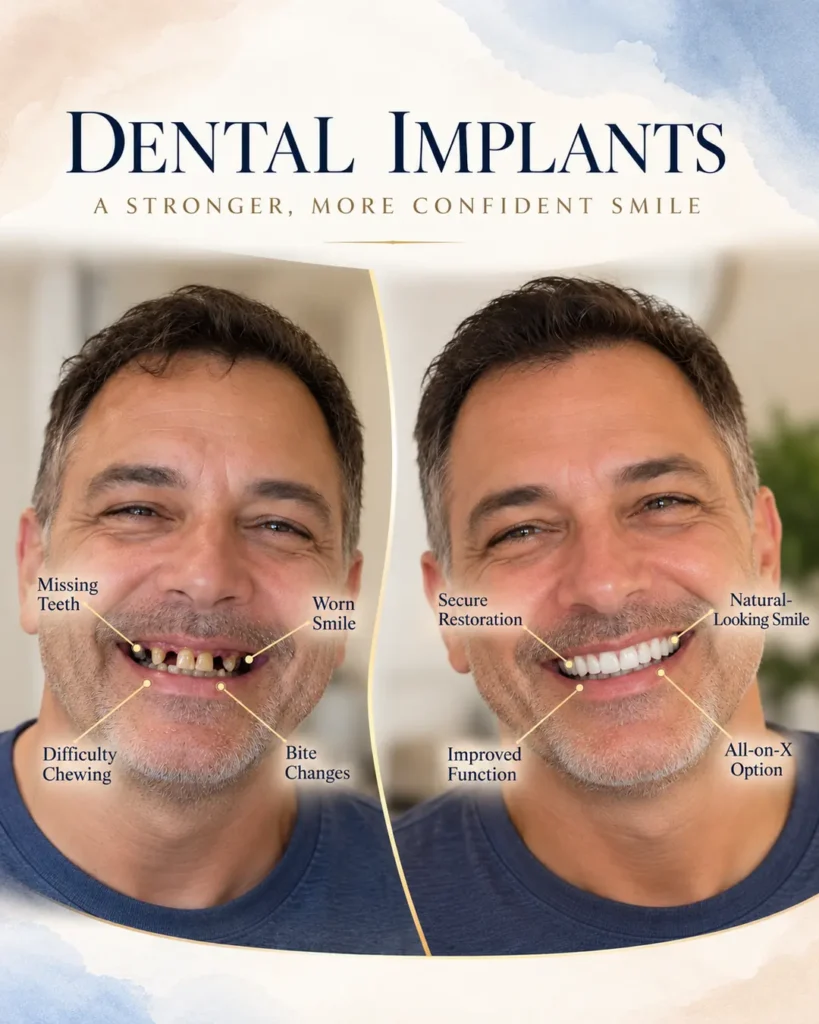
For many people, the appeal is not simply cosmetic. A stable implant-supported restoration can help address concerns such as dentures that move while eating, difficulty chewing certain foods, worry about dentures shifting while speaking, extensive missing or failing teeth, or wanting a fixed alternative to removable dentures.
Frequently Asked Questions
How many implants do you need for a full arch?
There is no universal number. Your dentist determines the configuration after evaluating your bone, bite, anatomy, and restorative needs.
Is All-on-X better than All-on-4?
Not automatically. All-on-X describes a customizable approach, while All-on-4 specifies four implants. What is appropriate depends on the individual case.
Can I get full-arch implants if I have bone loss?
Possibly. Bone loss can influence implant placement and sometimes leads to additional procedures such as grafting, but it does not automatically eliminate implant treatment as an option.
Are fixed implant teeth removable?
Not by the patient. Your dental team can remove a fixed restoration when professional maintenance or repairs require it.
| Explore Full-Arch Dental Implants at Creative Dentistry & Medspa
If missing teeth or unstable dentures are affecting the way you eat, speak, or smile, the most useful first step is finding out what your anatomy and smile actually need. Our team can evaluate your oral health, bone, bite, existing teeth, and restorative goals to determine which full-arch dental implant approach may be appropriate. Schedule a personalized dental implant consultation at our Alpharetta or Covington location to explore your options. |
Sources
Cleveland Clinic – Dental Implants: Types, Purpose & Benefits: https://my.clevelandclinic.org/health/treatments/10903-dental-implants
Cleveland Clinic – Implant-Supported Dentures: https://my.clevelandclinic.org/health/treatments/24303-implant-supported-dentures
American Academy of Periodontology – Full Mouth Dental Implants: https://www.perio.org/for-patients/periodontal-treatments-and-procedures/dental-implant-procedures/full-mouth-dental-implants/
Posted on behalf of Creative Dentistry & MedSpa