

If you are considering a dental implant and have been told that you may need a bone graft first, you probably have one immediate question:
Why?
Dental implants depend on the jawbone for support. When there is not enough healthy bone in the area where an implant needs to be placed, bone grafting may be recommended to create a stronger foundation.
The encouraging part is that needing a bone graft does not automatically mean you are a poor candidate for dental implants.
At Creative Dentistry of Atlanta in Covington, we evaluate your bone, gums, remaining teeth, bite, and overall treatment goals before determining the appropriate path toward replacing missing teeth.
Why Does Bone Matter for a Dental Implant?
A dental implant replaces the root portion of a missing tooth. It is surgically positioned within the jawbone, where the surrounding bone heals around and stabilizes it.
Cleveland Clinic explains that dental bone grafting can increase eligibility for dental implants by rebuilding areas where jawbone has been lost.
Bone Gives the Implant Its Foundation
Your implant treatment plan needs adequate bone:
- Around the implant
- At the appropriate height
- At the appropriate width
- In a position that supports the final restoration
A successful cosmetic result also requires thinking beyond the implant itself. The location and shape of the surrounding bone can influence gum support and the appearance of the finished tooth.
Why Would You Lose Jawbone?
Bone volume can decrease for several reasons.
A Tooth Has Been Missing for a Long Time
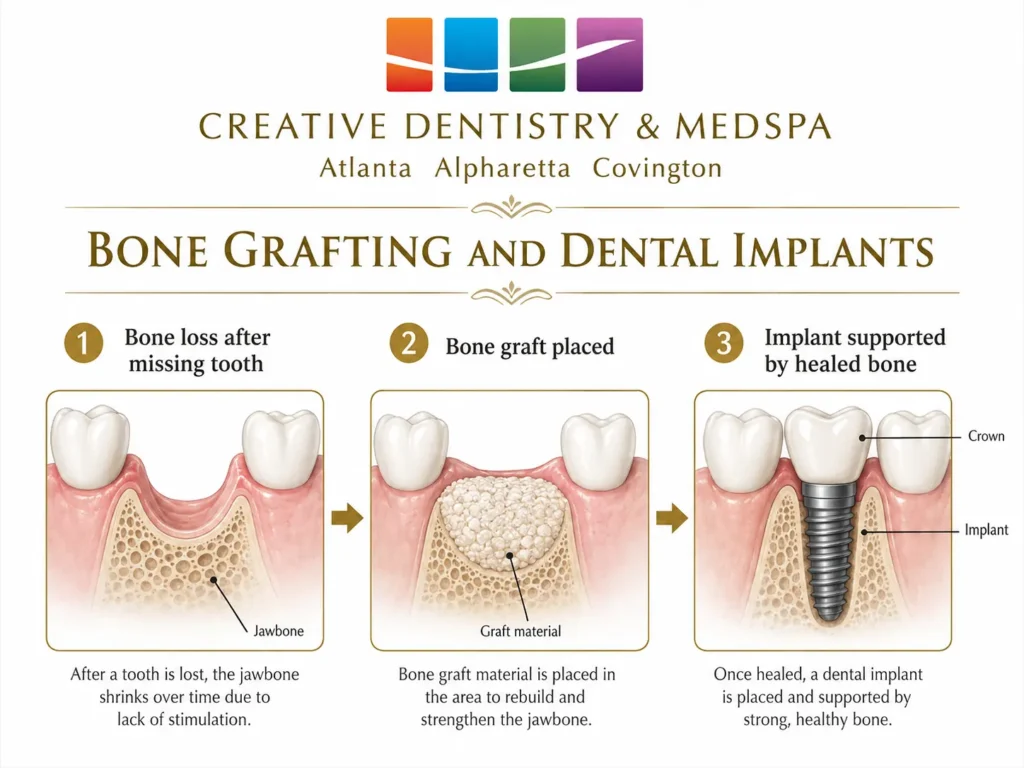
After a tooth is lost, the bone that once supported its root can gradually shrink because it no longer receives the same stimulation.
This means someone who lost a tooth several years ago may have different implant needs than someone replacing a recently lost tooth.
Gum Disease Has Damaged Supporting Bone
Advanced periodontal disease can destroy bone around natural teeth. If that tooth is eventually lost or extracted, additional reconstruction may be required before an implant can be placed.
Infection or Trauma Has Affected the Area
A severe dental infection, fractured tooth, previous extraction, or facial injury may also leave insufficient bone.
Does Everyone Getting Dental Implants Need a Bone Graft?
No.
Many patients have enough healthy bone to receive an implant without a separate grafting procedure.
Cleveland Clinic notes that a specialist may perform a bone graft when there is not enough bone remaining to place the implant.
The decision depends on your anatomy and the exact implant site.
How Do We Determine Whether You Need Bone Grafting?
Your dental implant consultation begins with a clinical examination and appropriate dental imaging.
Your Dentist Evaluates More Than Bone Quantity
Treatment planning may consider:
- Width and height of available bone
- Location of nearby nerves and sinuses
- Gum health
- Remaining teeth
- Bite forces
- Position of the future implant crown
- History of infection or periodontal disease
- Overall health and healing factors
In implant dentistry, the final tooth position should help guide where the implant needs to go.
Advanced Imaging Can Help With Planning
Three-dimensional imaging may be recommended when detailed information about the jaw and surrounding anatomy is needed.
The goal is to understand your starting point before treatment begins.
What Happens During a Dental Bone Graft?
A dental bone graft places grafting material in an area where additional bone is needed.
The material serves as a framework that supports your body’s healing and bone-regeneration process. Cleveland Clinic describes dental bone grafting as a procedure used to add volume and density to areas of the jaw where bone loss has occurred.
Depending on your situation, grafting may occur:
- At the time a tooth is removed
- Before implant placement
- At the same appointment as implant placement in selected cases
Your dentist or surgical provider will determine the appropriate approach.
How Long After a Bone Graft Can You Get an Implant?
Healing time varies.
Some grafts require several months before the area is ready for implant placement. Smaller procedures may follow a different timeline, and certain patients may be able to receive a graft and implant during the same procedure.
The American Association of Oral and Maxillofacial Surgeons recognizes bone and soft-tissue reconstruction as an important component of preparing implant sites when needed.
Your treatment timeline should be based on how your own jaw heals rather than a fixed calendar.
Frequently Asked Questions About Bone Grafts and Implants
Can I still get implants if I have bone loss?
Potentially, yes. Bone grafting exists specifically to help rebuild areas where bone volume is insufficient. The amount and location of bone loss determine your options.
Is bone grafting always done before the implant?
No. Depending on the defect and implant stability available, grafting may be performed before, during, or occasionally immediately after another related dental procedure.
What if my tooth was removed years ago?
You may still be a candidate for an implant. Because bone can change after tooth loss, updated imaging is important for determining whether grafting or another approach is appropriate.
Does All-on-4 require bone grafting?
One reason full-arch implant planning differs from single-tooth implant treatment is that implant position can sometimes be selected to use available areas of stronger bone. Some All-on-4 patients may avoid extensive grafting, while others may still require additional procedures. Your anatomy determines the treatment plan.
Find Out What Your Implant Treatment Actually Requires
Being told that you have bone loss does not end the conversation about dental implants.
It means your treatment needs careful planning.
Schedule a dental implant consultation with Creative Dentistry of Atlanta in Covington. We serve patients from Conyers, Oxford, Social Circle, Loganville, Snellville, and surrounding communities who want a personalized approach to replacing missing teeth.
We can evaluate your bone, review your implant options, and explain clearly whether grafting belongs in your treatment plan.
Schedule your implant consultation today and take the first step toward rebuilding your smile.
Cleveland Clinic. “Dental Bone Graft: Process, Purpose & Healing.”
https://my.clevelandclinic.org/health/treatments/21727-dental-bone-graft
American Dental Association, MouthHealthy. “Dental Implants.”
https://www.mouthhealthy.org/all-topics-a-z/implants
American Association of Oral and Maxillofacial Surgeons. “Dental Implants.”
https://aaoms.org/wp-content/uploads/2024/05/Dental_Implants_4.pdf
Posted on behalf of Creative Dentistry & MedSpa